

Liquid Gold Rush
The Sizzle & Drizzle Industrial Complex

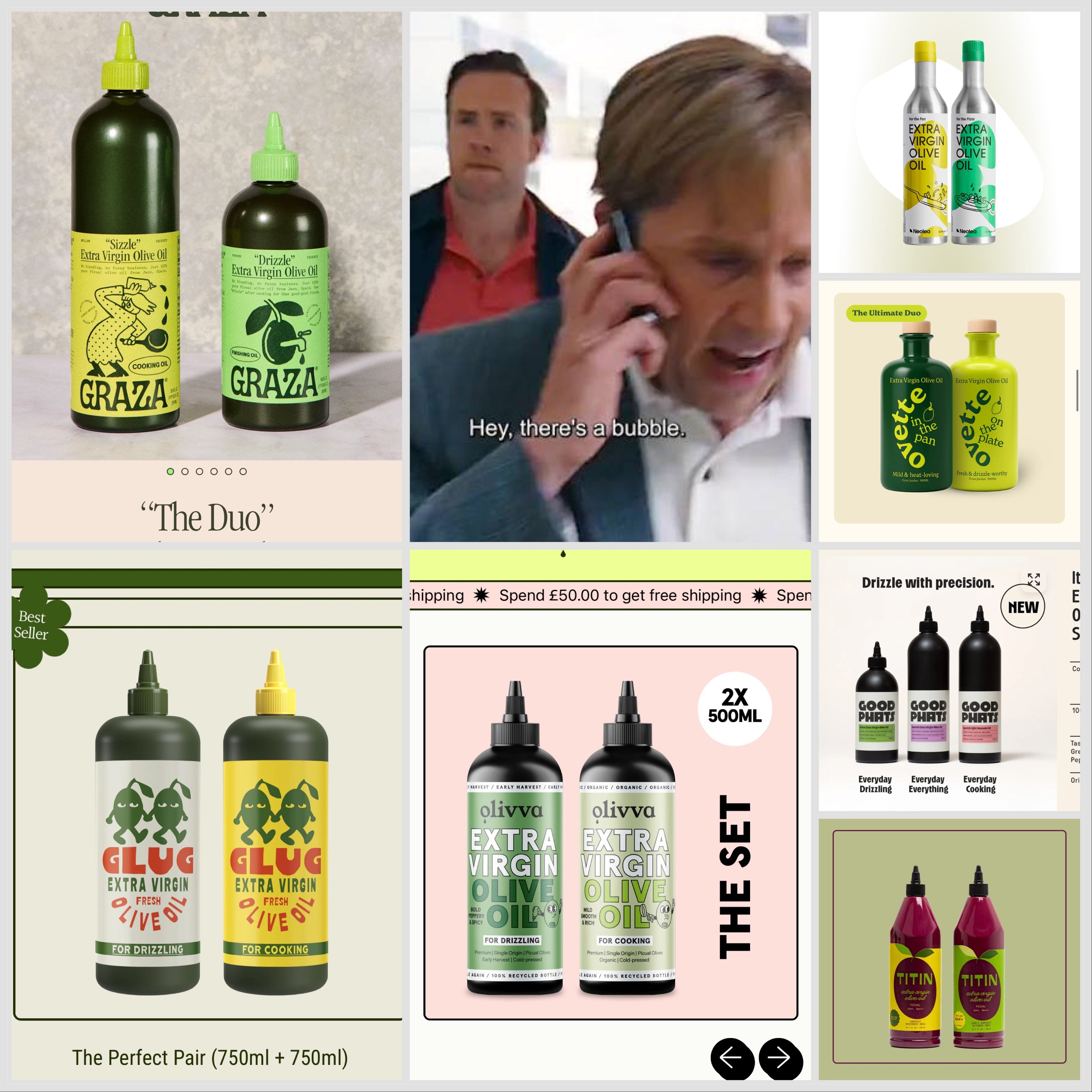
If you’ve watched a recipe video online in the past 3 years then you will have seen it. That bottle, spiralling a drizzle of olive oil into a pan. But wait, is it that bottle? Every few months, another brand appears in the same millennial-green hue and wobblier-than-thou typeface, promising to “make olive oil fun again.” They all sell a Cooking and a Finishing version, with names that sound like minor Pokémon evolutions: Graza, Olivva, Ovette, Glug, Neolea.
The founders always tell the same story: they were “tired of boring supermarket olive oil” and decided to create one that “looks as good on your counter as it tastes on your salad”, all delivered in a brand voice pitched somewhere between a podcast host and a golden retriever.
It’s not just marketing convergence; it’s aesthetic groupthink, the cult of Quirk™. No punctuation, sage-and-sea-foam palettes, lowercase copy that feels like it’s whispering affirmations. You could line up five of these bottles and play Guess the Brand Equity. Even the taglines are indistinguishable: meet your new kitchen crush; cold-pressed, never stressed; your countertop just got hotter; drizzle me, daddy (the last one is mine, you can have that for free). It’s that relentlessly upbeat Innocent Smoothies/Oatly school of copy that once felt charming and now lands with the thud of a grown man wearing a bobble hat indoors. The same chirpy, over-familiar voice that once told you your smoothie “had a nice little sit-down in the fridge” has been resurrected for olive oil.
To be fair, Graza did it first and did it well. The cooking/finishing split was genuinely smart — both educational and enviably Instagrammable — and the squeezy bottles were a revelation for anyone who hadn’t worked in a kitchen. But the moment it worked, the clones arrived like fruit flies. Glug and Olivva both sell “For Cooking” and “For Drizzling” oils, made from the same Spanish olives in the same squeezy bottles that look like Graza’s slightly shyer cousins. Ovette calls theirs “In the pan” and “On the plate”. Neolea, not to be outdone, has “For the Pan” and “For the Plate,” presumably after a gruelling three-month naming sprint.
This is Direct To Consumer monoculture at its ripest: olive oil as Aesop. Something to display, ritualise, photograph at golden hour. A bottle that promises not just flavour but a personality test result. You can almost feel the branding agency’s moodboard leaching through the plastic.
There’s something deliciously ironic about watching an ingredient as ancient and hyperlocal as olive oil, the lifeblood of Mediterranean cooking, get reborn as a lifestyle accessory for Instagram. It’s cultural laundering in the gentlest sense: thousands of years of agrarian craft, repackaged as content for people who own a good apron and at least one opinion about Maldon (lol me).
Meanwhile the supermarket bottles these startups claim to disrupt are quietly starting to look, dare I say it, distinguished. The oil inside might be dull, but Filippo Berio, with its frumpy fonts and gold foil, suddenly reads as reassuringly honest. There’s no winking copy, no anthropomorphic verbing, no implication it wants to be your “kitchen crush.” Maybe that’s the real test: when design trends cycle so hard that the most ‘authentic’ thing left is the thing they were originally running from.
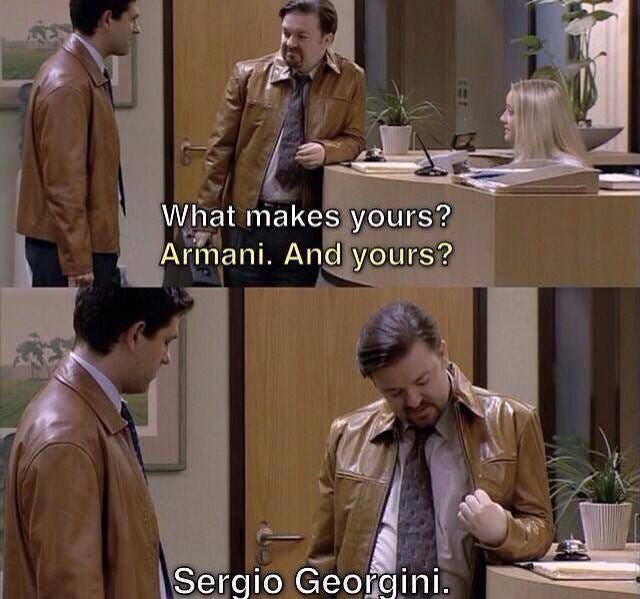
I started writing this purely as an observation of a trend — really it was just an excuse to post my Steve Carell in The Big Short meme — not as a critique of the products themselves (I haven’t tasted most of them). I don’t think any of these products are bad per se, some are genuinely quite good. Graza’s ‘Drizzle’, for example, is a perfectly decent, peppery finishing oil for a good price. It’s not the best olive oil you can buy, but for $21 it isn’t the worst thing to put on a tomato. Their ‘Sizzle’, though, is less compelling: a mild, unremarkable cooking-grade olive oil. There’s nothing wrong with it, except the fact you can buy the same thing at a supermarket for half the price. The genius isn’t what’s inside the bottle, it’s the bottle itself.
If you’ve ever worked in a kitchen, the sight of olive oil in a squeeze bottle is about as novel as seeing a chef wearing an apron. Part of your mise en place is always refilling these little plastic bottles from the big metal tins in the dry store. Graza’s genuinely clever move was to sell that setup pre-packaged for home cooks, and everyone else has copied the homework, right down to the bottle silhouette (which is just olive oil in a sriracha bottle).
Plastic, however, is no longer in vogue, so some of these brands are now re-adopting glass. Graza has just launched glass bottles (and honestly, I love this journey for them), truly a full circle moment. A 750ml glass bottles of ‘Sizzle’ is $20 (£15.20), which is rather lofty for a deliberately mild, personality-free cooking oil. More than double the price of Waitrose Extra Virgin at £8 a litre, and certainly not twice as good.
It is fascinating watching these branding tides sweep through the food internet every few years. Once in a while, they actually change the way we eat. Bold Bean Co. didn’t invent jarred beans; Spain, Italy, Turkey and half of Latin America have been quietly jarring transcendent legumes for decades. What Bold Bean did was put good beans in a taller jar, give them a catchy name, and talk about them as if they were narcotics-grade. And it worked. Suddenly, jarred beans were the main character: people were spooning them lovingly over sourdough, sirring them into soffritto and calling it dinner. They reframed an existing ingredient, popped on some bubbly typography, and in doing so, made beans… desirable. Now supermarkets like M&S are making own-brand jarred beans as a direct response. Tinned fish is currently undergoing a similar revival rebrand, and as a lover of good tinned fish I say bring it on.
That is the pattern: take something humble, repackage it with a knowing wink, and watch the internet rediscover it as if it were fire. I don’t mind that; this is not a criticism, merely an observation. Some of these products are great. I’m all for anything which gets people interested in thinking about ingredients and cooking more with them. It’s just fascinating to see how modern branding can reach back, pick up an existing, perfectly ordinary food, and through the alchemy of design, tone of voice and Instagram choreography, turn it into a cultural moment.
I love to see your marketing degree and cooking expertise collide
Certainly our olive oil isn’t a lifestyle accessory for Instagram. This does not apply to all small production olive oil makers. We don’t do a second pressing so there is no sizzle coming from us!