

Poor Man's Potatoes
Boil 'em, Mash 'em, Stick 'em in a Stew: A Sobremesa Special

Before we get to today’s recipe, a quick thank you to everyone who came to the first Sobremesa a few weeks ago! We had the best time cooking, teaching, and eating with you all. Another big thank you from me to everyone who worked so hard to make it happen; Nicola, Milli, Holly, Gitai, Justin and Giles. Plus a huge thanks to Clare for the beautiful photos in this post! For everyone else reading and wondering what I’m talking about, today we’re sharing some of the recipes from the Sobremesa retreat that Milli and Nicola (click through for their recipes!) hosted in August with help from a few friends.


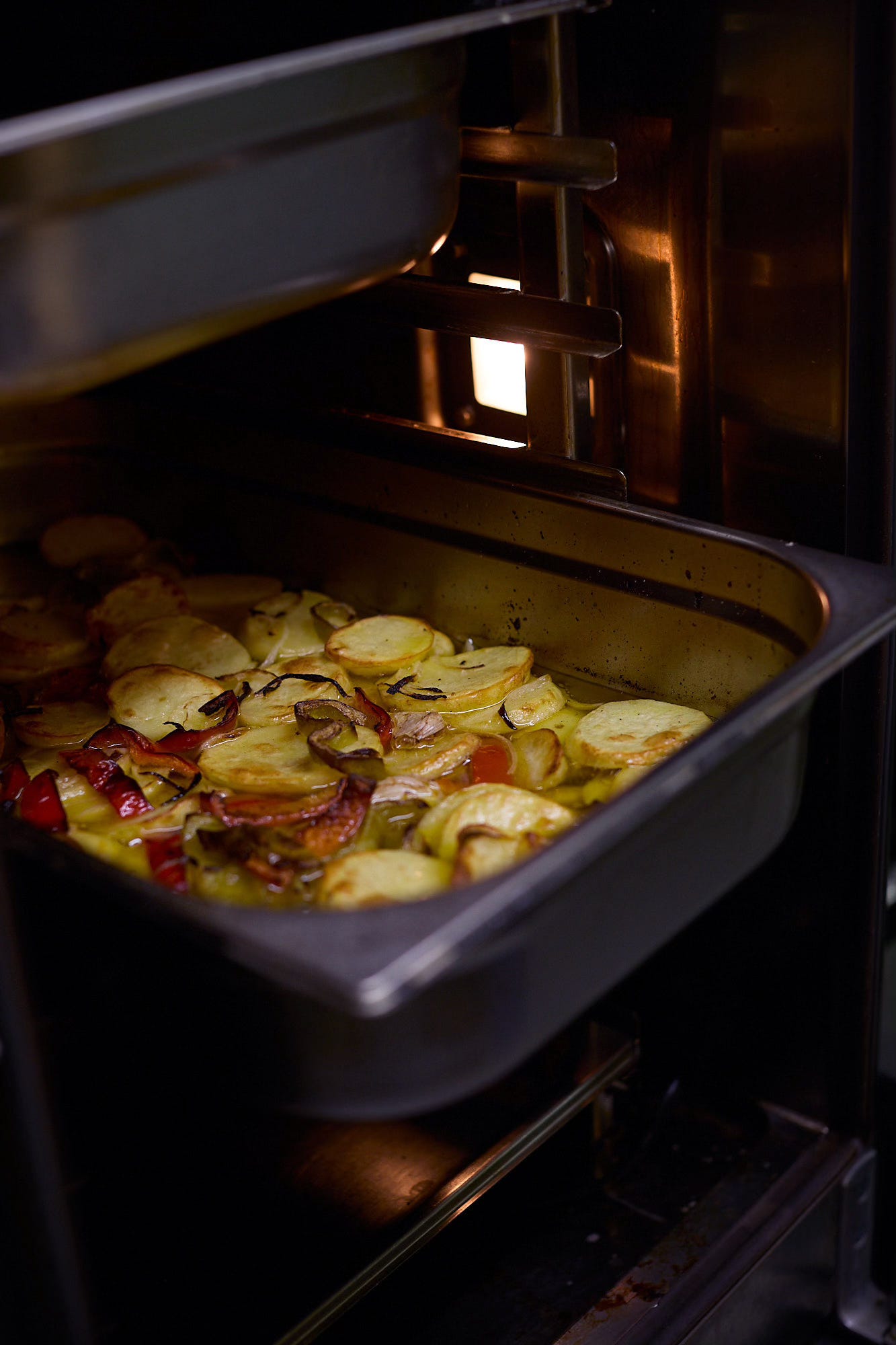
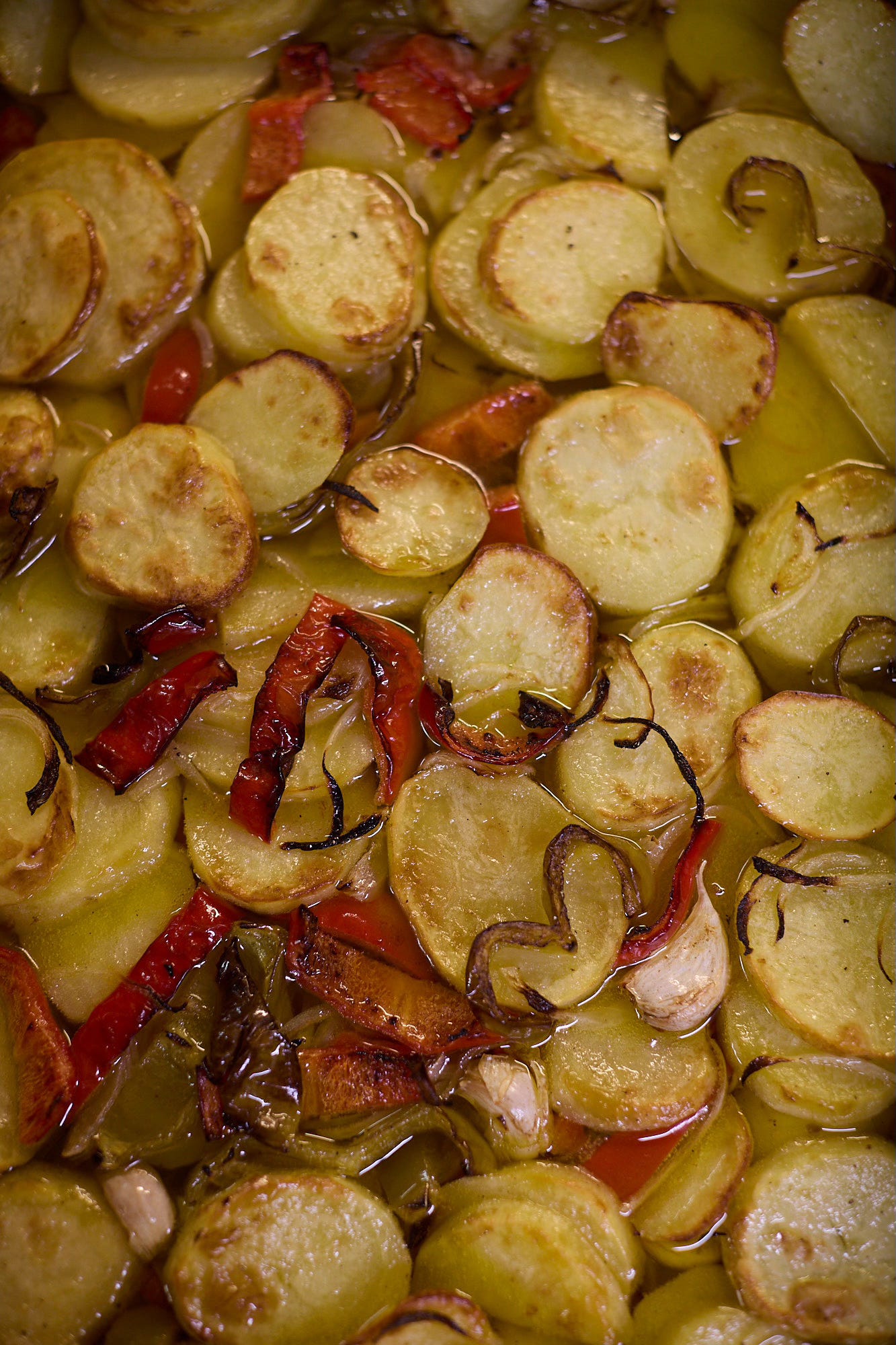
There’s an old Spanish dish with a name as elementary as its origins: patatas a lo pobre, literally ‘potatoes of the poor.’ At its simplest, it is little more than potatoes cut into thick coins and fried gently in olive oil with onions and peppers until soft and collapsing, almost stewed rather than fried. The aim here isn’t the shattering crispness of French fries, but a slower, humbler transformation. Starches melt into sweetness, peppers soften into their own syrup, onions fold into transparency.
The dish belongs to Andalusia, which is where I first learned about it when Milli taught me how to make it in a single sentence. “Slice up the potatoes, peppers and onions and bake them gently with lots of olive oil, garlic, bay and salt.” I immediately knew this was my kind of dish, and sent some pictures of it to my friend Mitch who has an encyclopaedic knowledge of Italian food and I knew would recognise its similarity to the potato cookery of Southern Italy.
Considering how integral they are to the cuisine, potatoes and peppers only arrived in Andalusia relatively recently, after the Spanish conquest of the Americas. Peppers were adopted faster, but potatoes only became part of the local cuisine in the late 1700’s. Most people couldn’t afford meat often, but they had oil, peppers and onions, and perhaps an egg cracked on top. In that context, patatas a lo pobres is less a recipe than a strategy; stretch what little you have, turn cheap starches into a meal and make the pan do the work.
The genius of patatas a lo pobre is not uniquely Spanish. This ‘poor’ food mirrors other similar dishes across the Mediterranean. In Naples, friggitelli con le patate (peppers stewed down with potatoes) tells a similar story of New World ingredients, brought to Naples by the Spanish and stitched into the traditional fabrics of country cooking. In Provence, pommes à la sarladaise (potatoes cooked in duck fat) shows another rural solution reflecting its surroundings. Each place found its own way to turn this humble tuber into joyful sustenance.
And so, patatas a lo pobre persists not just because it’s cheap, but because it’s delicious. The technique - low heat, plenty of oil and a little patience - turns modest ingredients into something sublime. Like all the best cooking, it’s greater than the sum of its parts. Restaurants now sometimes garnish it with things like jamón, or fry an egg on top, but the core is unchanged. Potatoes, oil, peppers, onions; ‘poor man’s potatoes’ have become a symbol of plenty that is good.
To cook them is to practice thrift and generosity at once. You need time more than money, a wide pan is the only tequirement. The result is food that can feed many and any, a dish as at home on a farmers table, or indeed your table, as any tapas menu.
The Recipe
1kg Waxy Potatoes
1 Onion, thinly sliced
2 Small Bell Peppers, ideally 1 green 1 red, sliced into strips
3 whole Garlic Cloves, lightly crushed
250ml Olive Oil (yes, this much, don’t be shy)
2 Bay Leaves
A small splash of Sherry Vinegar (optional, but traditional in some places)
The Method
Peel the potatoes and cut them into ½ cm rounds. Rinse briefly under cold water to wash off some of the starch, then pat dry.
Preheat your oven to 200c.
To a wide oven dish, add the potatoes, onions, peppers, garlic, and bay with a tsp of salt. Mix well, pour in the oil and mix again.
Place into the oven and let the vegetables cook slowly. You don’t want a fierce fry; instead, think of it as a shallow confit. Stir occasionally to prevent sticking. After 25–30 minutes, the potatoes should be tender with a few browned edges, the onions translucent, and the peppers silky.
If using vinegar, splash it in at the end and let it evaporate for a few seconds. Remove from the oven, taste and adjust salt.
Don’t forget to check out the other recipes from the retreat here and here! There’s lemon leaf panna cotta, ajo blanco, tuna toastadas and more…
To cook them is to practice thrift and generosity at once. Absolutely!!